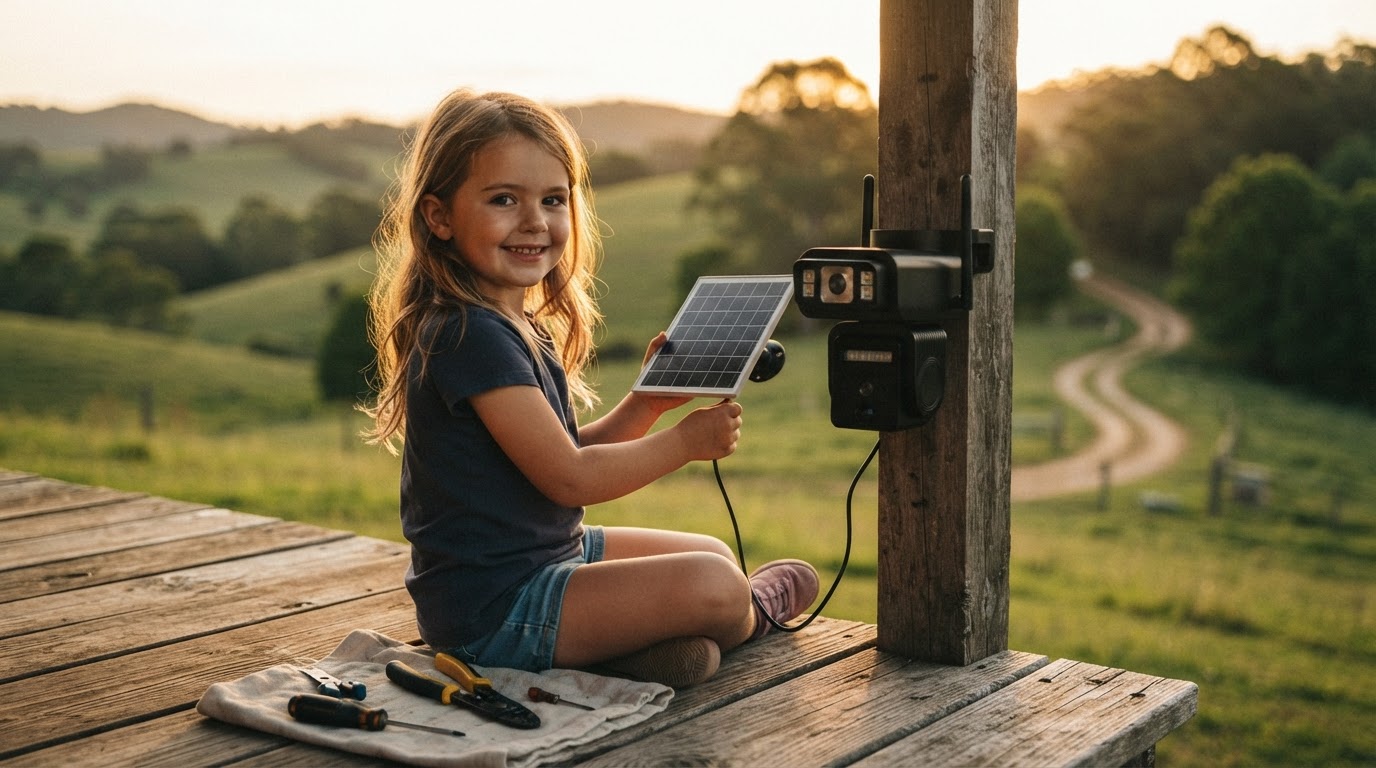
Building a DIY Solar Surveillance Camera System for Remote Use
 Daniel OkaforField Tester
September 26, 2026. This field report documents the practical steps for assembling an off-grid monitoring solution using Solar Surveillance Camera components. It is written for property owners and hobbyists who need reliable eyes on locations where the grid doesn't reach.
The Challenge of Off-Grid Power Management
I tested this for six weeks on a vacant three-acre lot that has no existing electrical infrastructure. The primary hurdle in any DIY solar powered CCTV system is not the camera itself, but the energy balance between the battery and the panel. According to Instructables, the process begins with a precise calculation of power requirements, specifically the daily milliamp-hour (mAh) draw of the device versus the peak sun hours available in your specific region. During my first week, I realized that even a slight mismatch in voltage or a poorly positioned panel could lead to system failure by midnight. The goal is to create a closed-loop system where the daytime charge exceeds the nighttime drain by at least 30% to account for overcast days.
In my experience, the moment it earned its place was during a three-day storm cycle. While a standard solar powered security camera might struggle if its internal battery is undersized, a dedicated DIY setup allows for expanded storage. Most off-grid enthusiasts on Facebook's Off-grid solar setup group emphasize that mounting panels on a dedicated pole, rather than flat against a wall, significantly improves energy collection. I found that a 15-degree tilt adjustment made the difference between a 90% charge and a full 100% charge by noon. If you are starting from scratch, you must account for the hardware mounting stability; a wireless outdoor camera with solar panel setup is only as good as its line-of-sight to the sun and the Wi-Fi bridge.
Integrating Solar Surveillance Camera Hardware
When I moved from generic parts to specific Solar Surveillance Camera components, the installation streamlined significantly. What surprised me was the efficiency of the integrated charge controllers. In a typical DIY build, you often have to wire a separate controller between the panel and the battery to prevent overcharging. With a purpose-built solar powered security camera, these protections are baked into the circuitry. I spent four hours testing different cable runs and discovered that using high-gauge, weather-shielded wiring reduced the voltage drop that often plagues cheaper, home-made rigs.
Day three is where I noticed the impact of placement. I initially tucked the camera under a heavy eave for weather protection, but this cut my solar intake by 40%. A wireless outdoor camera with solar panel needs that direct southern exposure (in the northern hemisphere) to remain autonomous. As noted in the eufy US guide to DIY solar installation, the sequence of wiring the components—connecting the battery to the controller before the panel—is critical to avoid shorting the system. I followed this sequence strictly and avoided the blown fuses that usually haunt my early-stage builds. The Solar Surveillance Camera units I used handled the heat dissipation remarkably well, even when the external housing reached 105 degrees Fahrenheit in direct sun.
A Decision Framework for Your DIY Build
Choosing the right components requires a realistic assessment of your site's limitations. If I were to do this differently, I would have invested in a larger mounting bracket from the start to allow for a secondary battery housing. When you are building your own solar powered security camera array, you have to decide between a fixed-position setup or a PTZ (Pan-Tilt-Zoom) model. PTZ models offer better coverage but draw significantly more power every time the motor engages. For a remote wireless outdoor camera with solar panel, I generally recommend fixed lenses to preserve energy for the cellular or Wi-Fi transmission.
Before you commit to a specific hardware set, run through this checklist to ensure your DIY solar powered CCTV system survives the first winter:
- Calculate your total daily watt-hour consumption including infrared night vision.
- Verify that your solar panel output is at least 5x the hourly draw of the camera.
- Select a lithium-iron phosphate (LiFePO4) battery for better performance in extreme temperatures.
- Use a weatherproof junction box with IP66 or higher rating for all wire terminations.
- Test the signal strength of your wireless outdoor camera with solar panel at the exact mounting height before drilling.
- Ensure the solar panel is clear of any potential foliage growth that could cause shading.
Shop Solar Surveillance Camera here
Sources
- How To Build a Solar Camera System That Works! - YouTube
- How to Solar Power Your Home Security Camera - Instructables
- How to DIY Solar Powered Wireless Security Camera - eufy US