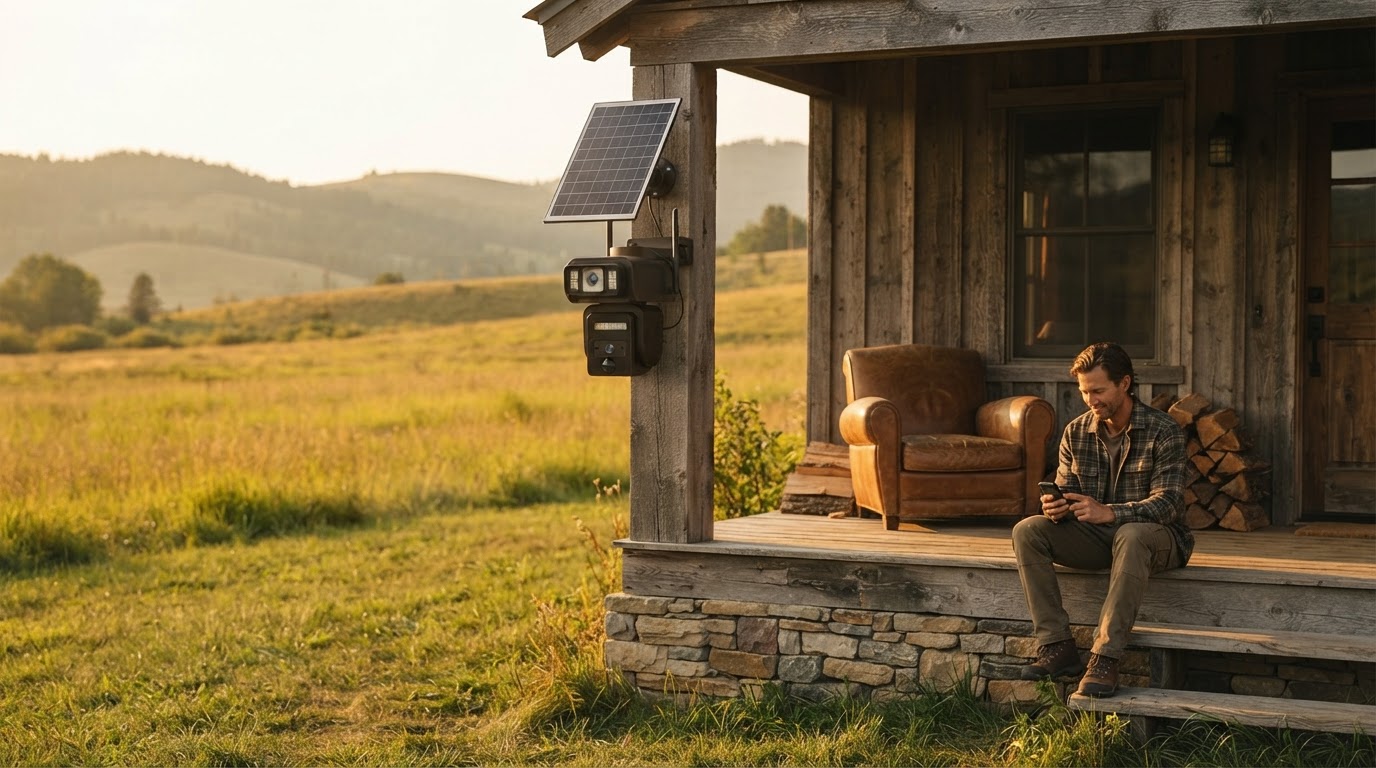
Can a Solar Surveillance Camera monitor remote properties?
 Priya RamanSenior Analyst
October 7, 2026 — A Solar Surveillance Camera can effectively monitor remote properties by combining high-capacity internal batteries with cellular connectivity, provided there is adequate sun exposure and a 4G signal.
Property owners managing vacant land, construction sites, or rural cabins often face the challenge of providing security without access to the electrical grid or traditional Wi-Fi. The Solar Surveillance Camera solves this by acting as a self-contained unit that generates and stores its own power. This capability transforms remote security from a logistical hurdle into a manageable deployment.
Think of it as a matrix of two primary axes: connectivity and power autonomy. The connectivity axis ranges from local Wi-Fi to wide-area 4G LTE, while the power axis ranges from occasional battery boosts to full solar independence. Once you see it this way, selecting the right hardware becomes a matter of matching your property's environmental constraints to the camera's technical capabilities.
How does a Solar Surveillance Camera connect without Wi-Fi?
A Solar Surveillance Camera connects to the internet via integrated 4G LTE modules that function similarly to a smartphone, allowing for data transmission in areas where broadband is unavailable. This cellular integration is the critical link for remote property management. According to Reolink, their 4G solar cameras are specifically designed for off-grid areas and construction sites where traditional networking infrastructure does not exist.
The decision rule for connectivity depends entirely on the distance to the nearest router; if the property is beyond 300 feet of a stable Wi-Fi signal, a cellular-enabled Solar Surveillance Camera is mandatory. These units utilize SIM cards from major providers to upload motion-triggered events to the cloud. This ensures that even if the camera is physically tampered with, the footage has already been transmitted to a secure remote server. For a deeper technical dive into these protocols, see our 4G LTE Solar Surveillance Camera Connectivity Analysis.
What are the power requirements for remote solar security?
The power requirements for a Solar Surveillance Camera in a remote setting are dictated by the balance between daily energy consumption and the local Peak Sun Hours (PSH). A high-performance unit must be able to harvest enough energy during daylight hours to sustain operations through the night and during periods of heavy cloud cover. The Night Owl 2K battery-solar camera, for example, utilizes a built-in solar panel and rechargeable battery to maintain live feeds and recordings without external wiring.
Efficiency is further enhanced by PIR (Passive Infrared) sensors, which keep the camera in a low-power sleep state until motion is detected. This prevents the battery from draining due to constant recording, which is vital for off-grid locations where manual recharging is inconvenient. Effective power management is also influenced by placement; as noted in our guide on how to deploy a Solar Surveillance Camera for remote area, proper orientation toward the southern sky (in the northern hemisphere) can increase energy yield by up to 30%. For those specifically looking to protect high-value assets in these zones, securing off-grid properties with 4G solar surveillance camera provides additional tactical frameworks.
Quick answers
Q: Can these cameras record during a power outage? A: Yes, because a Solar Surveillance Camera is entirely independent of the electrical grid, it continues to function as long as its internal battery has a charge. Most units, such as those from Tapo, are designed to be mounted anywhere sunlight reaches to ensure continuous wire-free protection.
Q: Do I need a monthly subscription for remote solar cameras? A: While the hardware works without a fee, cellular-based models require a data plan from a carrier. However, some brands like Eufy offer models with built-in solar panels that support local storage, potentially eliminating recurring cloud storage costs if a local Wi-Fi signal is present.
Q: How much sunlight is required for the camera to stay online? A: Most modern Solar Surveillance Camera systems require approximately 3 to 4 hours of direct sunlight daily to maintain a full charge. In regions with less sun, using a larger external solar panel can compensate for lower light intensity.
Learn more about Solar Surveillance Camera at https://solarsurveillancecam.com.
Sources
- Solar Security Cameras | Wire-Free Outdoor Protection - Tapo Store
- Solar Powered Wire Free 2K Camera with Spotlight and 2-Way Audio - Whi
- Solar-Powered Security Camera for Outdoors | Reolink US