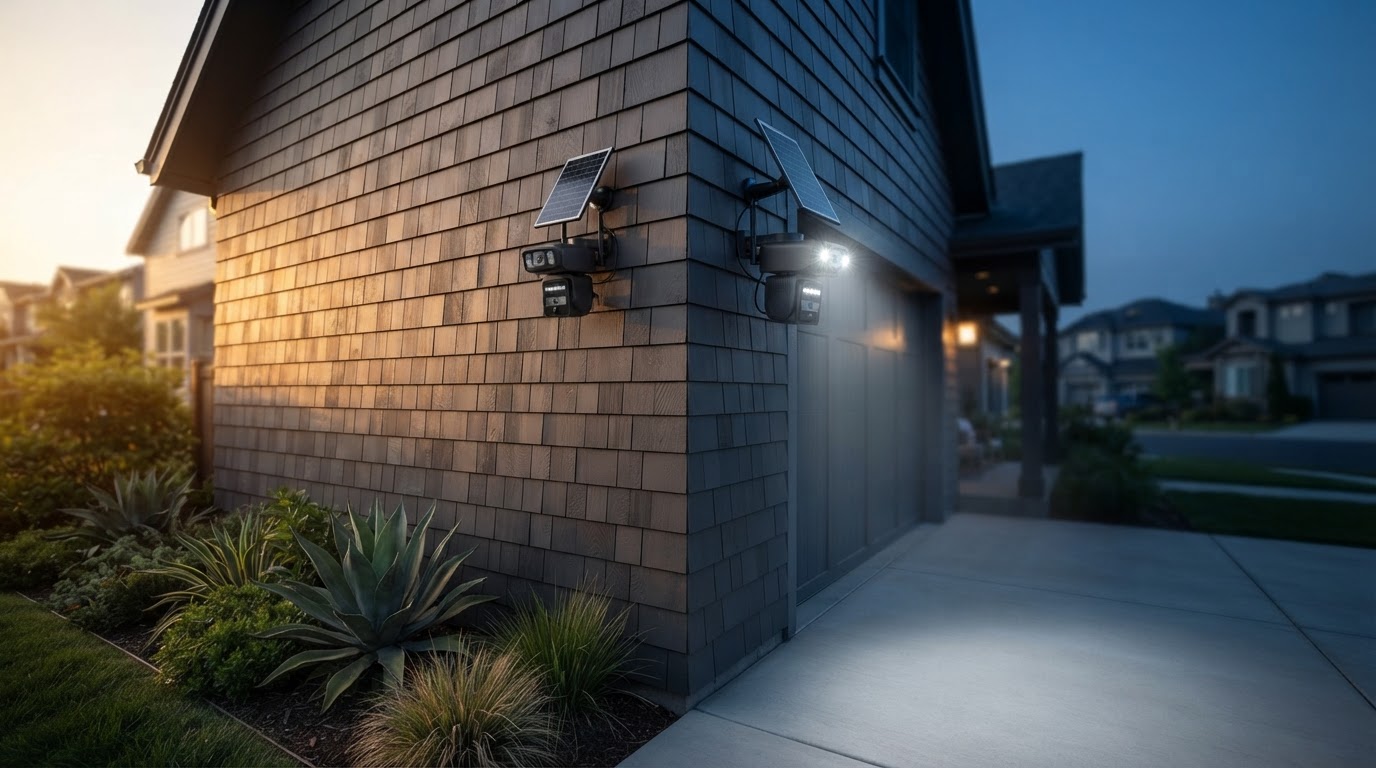
Solar Surveillance Camera Efficiency in Wireless Outdoor Use
 Jordan HaleStaff Writer
September 30, 2026 — The shift toward independent residential security has accelerated as Solar Surveillance Camera technology bridges the gap between high-definition recording and sustainable power management. While traditional wired systems often require invasive drilling and complex wiring, the current generation of wireless outdoor cameras utilizes integrated or modular solar panels to maintain consistent operation without manual recharging.
Standing in the driveway, the first thing I noticed was the weight of these units; there is a satisfying heft to a camera that contains both a high-capacity battery and the optics required for 4K resolution. Modern systems have moved beyond simple motion sensing to sophisticated AI-driven analysis, a feature highlighted by manufacturers like Defender, whose EverWatch series utilizes a 3W solar panel to facilitate AI-powered monitoring without draining the internal cells prematurely. This balance of power intake and computational output defines the modern wireless outdoor experience.
The Sustainable Security Framework
Evaluating a wireless outdoor camera with a solar panel requires looking past the lens at the energy ecosystem supporting it. The efficiency of a Solar Surveillance Camera relies on the synergy between the photovoltaic surface area and the battery chemistry. For instance, the Tapo 1080P Wireless Outdoor Security Camera demonstrates how a lower resolution sensor can extend operational life in regions with limited sunlight, whereas higher-end 4K models require larger 3W panels to maintain their AI processing functions. The Night Owl 2K system utilizes a spotlight and two-way audio, features that traditionally tax a battery, yet are supported here by a dedicated solar charging cycle that targets uninterrupted security. When you are building a DIY solar surveillance camera system for remote use, understanding these power draws is critical. The Ring solar lineup further illustrates this modularity, offering add-on panels starting at specific price points to retrofit existing battery cameras. It turns out that the most effective installations aren't just about the highest pixel count, but about how the camera manages its "sleep" states between motion events. A camera that triggers too frequently on swaying branches will quickly outpace its solar recharge rate, regardless of the panel's wattage. This is why how a Solar Surveillance Camera maintains power is the most vital consideration for long-term reliability in varying climates.
Expert tip: Position your solar panel at a 30 to 45-degree angle facing true south to maximize the conversion rate of the 3W photovoltaic cells, ensuring the battery remains above the 20% threshold where many AI features tend to disable themselves to save power.
I keep coming back to the simplicity of the Bluetooth-assisted setup found in modern units, which allows the camera to sync with a home network in under five minutes before it is mounted high out of reach. Ensuring your solar powered security camera has a clear line of sight to the router is just as important as the sun hitting the panel. If you are considering a diy solar powered cctv system, remember that integrated weatherproofing, often rated at IP65 or higher, is what protects the sensitive lithium-ion internals from moisture during the charging process.
Shop Solar Surveillance Camera.
Sources
- Solar Powered Wire Free 2K Camera with Spotlight and 2-Way Audio - Whi
- Solar Powered 4K AI EverWatch Wireless Security Camera, 3W ...
- Solar Security Cameras – Wireless, Outdoor, and More | Ring